Samarkand is a city in Uzbekistan, in Central Asia, inhabited for more than 2,500 years and for centuries one of the great stops on the Silk Road. It is famous for its turquoise domes and the Registan square, and also for its bread: Samarkand non, a round loaf with a stamped centre whose reputation reaches far beyond the city.
Our bakery is named after Samarkand because my husband is originally from this region and we now bake and cook Uzbek recipes in Tetouan. The bread that we offer in our home bakery is a homemade Obi Non, and NOT the legendary Samarkandi Non. If you read on, you will find out why we can't exactly replicate it.
Here is the city, the legend of its bakers and the place bread holds in Uzbek life.
Where is Samarkand?
Samarkand sits in the Zarafshan valley, about 300 km south-west of Tashkent, the capital. Its oldest part, the hill of Afrasiyab, goes back to the 7th or 8th century BC according to archaeologists.
For centuries its Sogdian merchants traded between China, Persia and India. Arab armies under Qutayba ibn Muslim entered the city in 712, and it grew into a great centre of learning: Imam al-Bukhari, compiler of the Sahih, is buried in a village close by.
A traveller from our part of the world got there long before us. Ibn Battuta, who set out from Tangier, passed through around 1333 and described it as one of the largest and most beautiful cities he knew, while noting that many of its palaces still lay in ruins after the Mongols.
Timur and his blue-domed capital
The Samarkand of postcards mostly belongs to Timur, known in Europe as Tamerlane. He made it his capital in 1370 and brought back masons, tile makers and calligraphers from his campaigns in Persia, Syria and India. They covered the city in blue and turquoise tiles.
The Bibi-Khanym mosque, begun in 1399, was one of the largest in the Muslim world. Timur lies nearby in the Gur-e-Amir, a mausoleum with a ribbed dome said to have inspired the Mughal tombs of India, the Taj Mahal included.
The Registan and Ulugh Beg's observatory
Registan means "sandy place" in Persian. Three madrasas line this old market square, and their tiled gateways are the best-known image of the country. The historic city has been on the UNESCO World Heritage List since 2001.
The oldest of the three is named after Ulugh Beg, Timur's grandson, who ruled the city for some forty years and loved the stars. In the 1420s he built an observatory with a huge meridian arc cut into a hillside. His catalogue of around a thousand stars was one of the most accurate made before the telescope. Pulled down after his death in 1449, the observatory was rediscovered in 1908, and you can still walk down into the trench of the arc.
Samarkand non, a bread apart
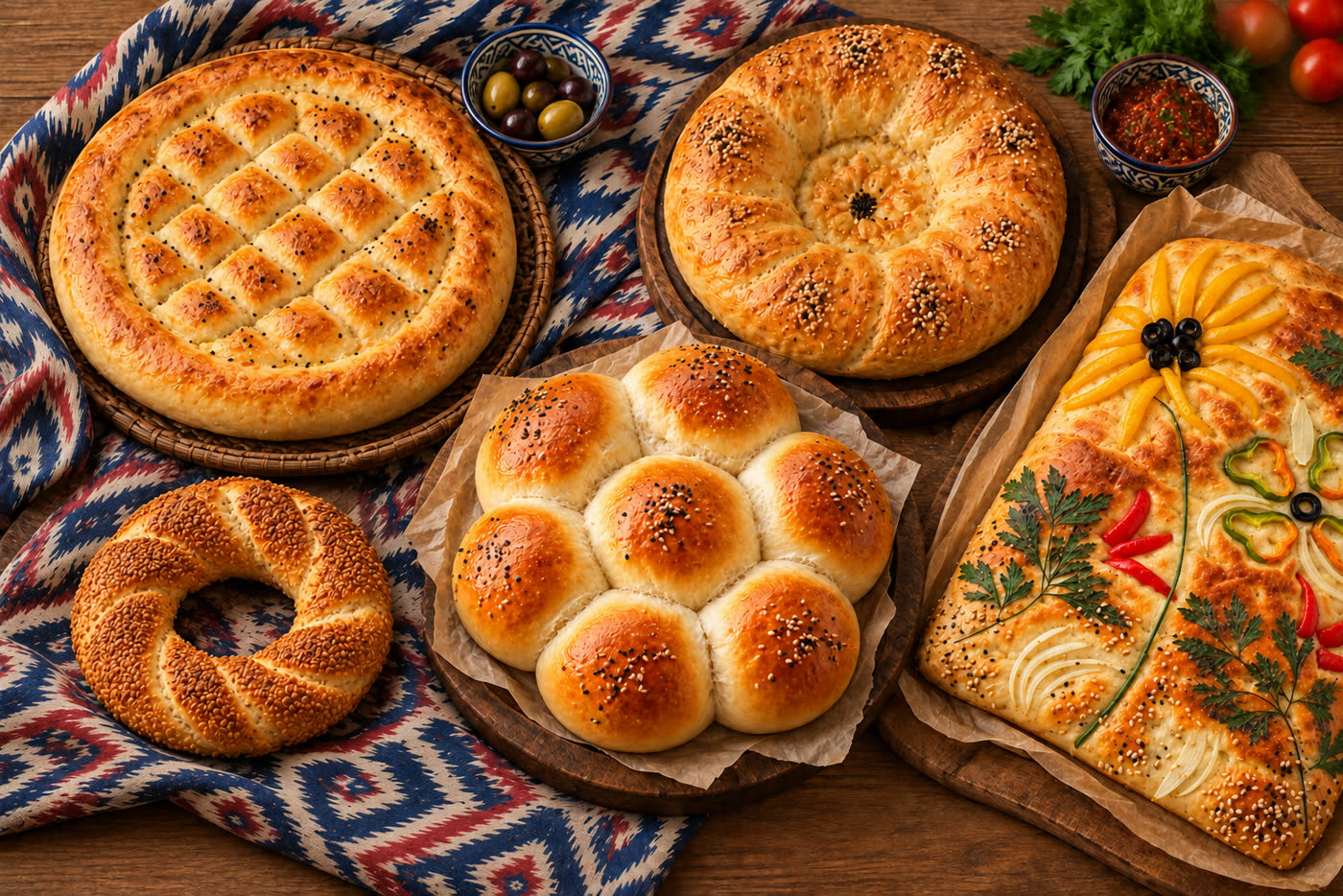
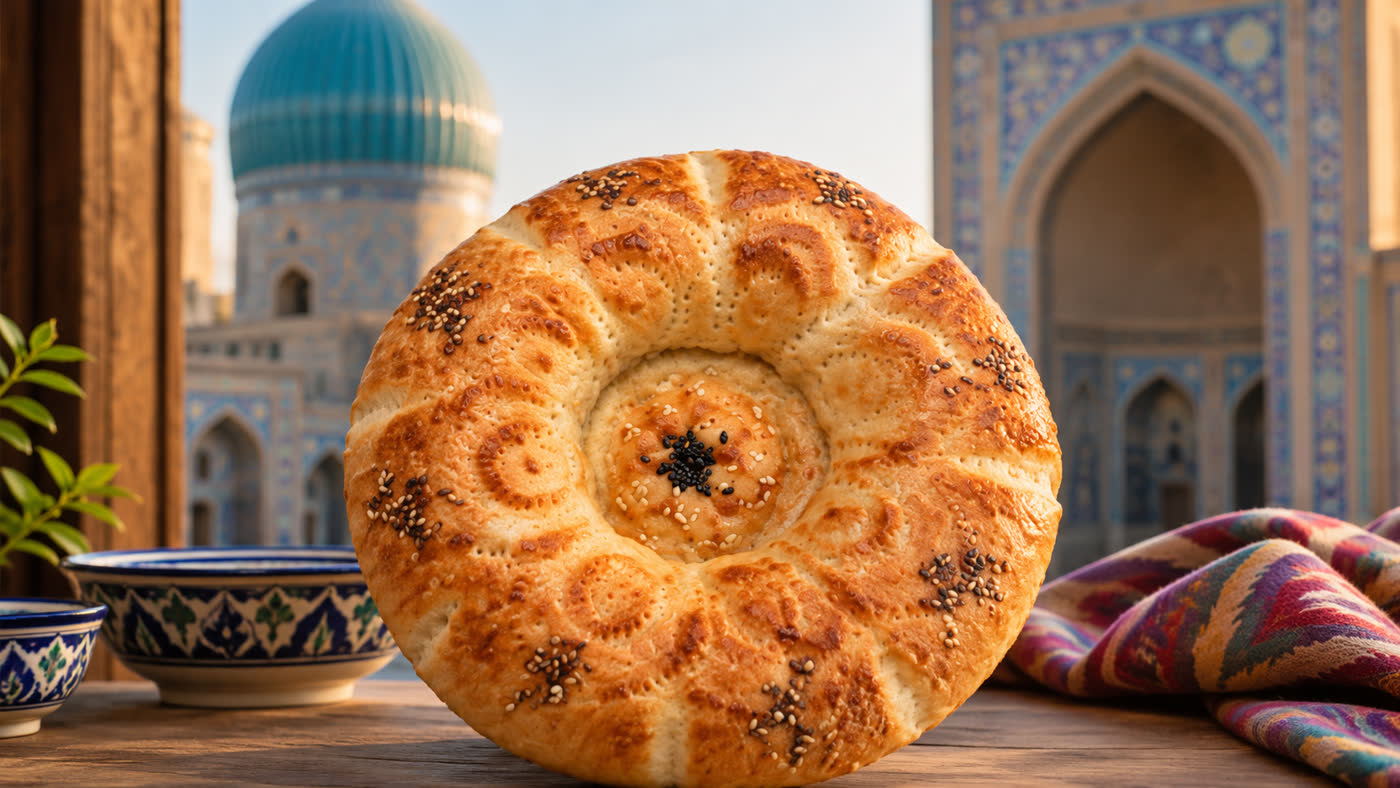
In Uzbek, bread is non, and there are many variations, from everyday obi non to flaky patir. Samarkand's is the most famous: round, with a thick, glossy rim and a flat, tight, patterned centre. Its milk-and-fat dough is kneaded for a long time, which gives it a dense crumb.
People say it keeps for weeks without going mouldy. It hardens, and a sprinkle of water and a few minutes in the heat soften it again.
The legend of the Samarkand bakers
A story everyone in Uzbekistan seems to know explains why this bread cannot be made anywhere else. In the most common version, an Amir of Bukhara loved Samarkand bread so much that he brought the city's best bakers to his court, with their flour, their water and, some say, their tandir. The bread came out golden. It just did not taste the same.
The bakers supposedly explained that the air of Samarkand was missing. True or not, the story says something every baker knows: bread depends on the place where it is made.
The chekich, the stamp that signs the bread
The pattern in the middle of a non comes from the chekich, a stamp with a handle and fine metal pins set in circles or rosettes. The baker presses it into the centre of the dough just before baking. The tiny holes stop the middle from rising, so only the rim puffs up and the centre stays flat.
People say a regular can recognise their baker by the stamp. Each Uzbek bread we bake is marked with a chekich too. At home, a fork does the job: prick the centre in tight circles, leaving about 2 cm of rim untouched.
The tandir, a clay oven
In Uzbekistan, non is baked in a tandir, a large jar-shaped clay oven traditionally fired with wood. The baker lays each round of dough on a padded cushion and slaps it onto the scorching inside wall, where it sticks. A few minutes later it comes off golden and blistered. Plenty of street samsa are baked the same way.
We have no tandir: our Uzbek bread is baked in an ordinary oven. So it does not have quite the crust of a non baked against clay, and we would rather say so. The shape and the stamp, though, are those of Uzbek non.
Bread as a matter of respect
In Uzbekistan, bread is close to sacred, and these rules hold in most families:
- Never put a non upside down, patterned side against the table: it is disrespectful, and some see it as bad luck.
- Don't cut it with a knife. At the start of the meal, the host or the eldest breaks it by hand and passes the pieces round.
- Never throw it away. Stale bread goes to the birds, and a piece dropped on the ground is picked up and put somewhere higher, as many Moroccans do too.
- Before a long journey, the person leaving takes a bite of a non. The rest is kept at home, and they finish it when they return.
For an engagement, Uzbeks even talk of "breaking bread": the two families share a non to seal the agreement.
What does an Uzbek meal look like?
It starts with the dastarkhan, the cloth laid before the guests arrive and covered with bread, dried fruit, nuts and sweets. Tea, often green, is drunk from small handleless bowls. By custom, the host fills them only halfway so they can top them up often: a full bowl can hint that it is time to leave.
| Stage | What is served |
|---|---|
| On arrival | Non, tea, dried fruit, nuts |
| Starters | Achichuk salad (tomato and onion), samsa |
| Soup | Shurpa (meat and vegetables) or mastava with rice |
| Main | Plov, manti or kebabs |
| To finish | Tea, fruit, melon in season |
The dish for big occasions is plov, rice cooked with meat, carrots and chickpeas. The non stays on the table from start to finish.
Our Uzbek bread and samsa in Tetouan
Our Uzbek bread is made with flour, milk, butter, an egg and a little yeast. It is shaped by hand, stamped, sprinkled with sesame or nigella seeds and baked in the oven. It is softer than Samarkand non, with a lightly crisp crust, and every loaf is made to order.
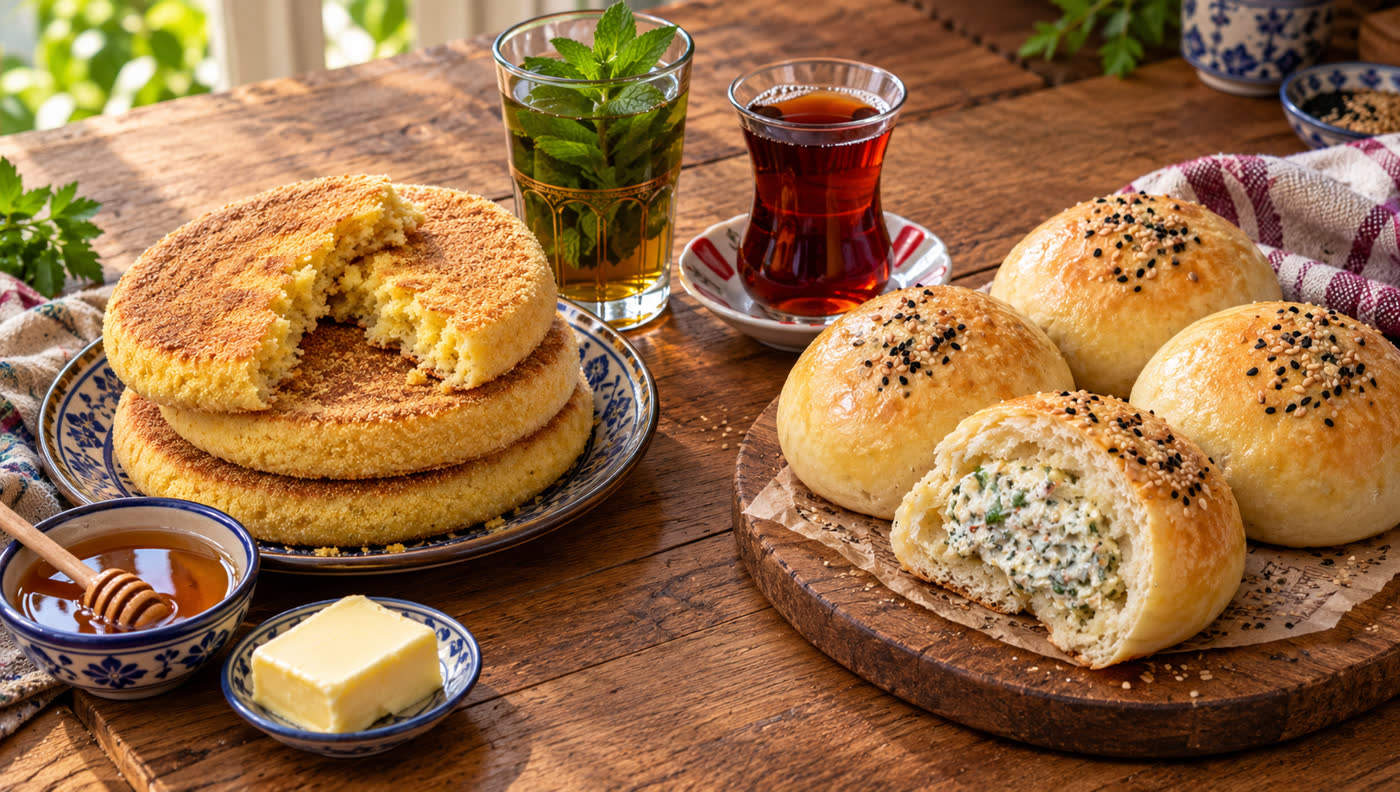
For an Uzbek-style meal, add a meat samsa, buttery puff pastry filled with minced beef, onion and cumin, or an Ochiq samsa, a soft bun left open over its filling of beef and potato (ochiq means "open" in Uzbek). With tea, a slice of Uzbek honey cake, the famous Uzbek take on the Russian medovik, rounds the meal off nicely.
All of them contain gluten and dairy, and all except the meat samsa contain eggs. The Ochiq samsa contains sesame; the bread and the meat samsa may contain traces of it.
Frequently asked questions
Why is Samarkand bread so famous?
For its dense crumb, how long it keeps, and the legend of the bakers taken to Bukhara.
What is a chekich?
A pin stamp that decorates the centre of Uzbek bread and stops it rising.
Is your Uzbek bread baked in a tandir?
No, in an ordinary oven. It keeps the shape and stamped pattern of Uzbek Obi Non.
What should I eat Uzbek bread with?
Tea, cheese, our homemade fig and walnut jam or soup. It also goes very well with harira or a tagine and makes a lovely gift when going to a friend's home for dinner.
Where to get our Uzbek bread in Tetouan
Order on our website, as early as you can since everything is made to order, then collect on Saturday or Sunday between 10:00 and 18:30 at Wilaya Centre in Tetouan.