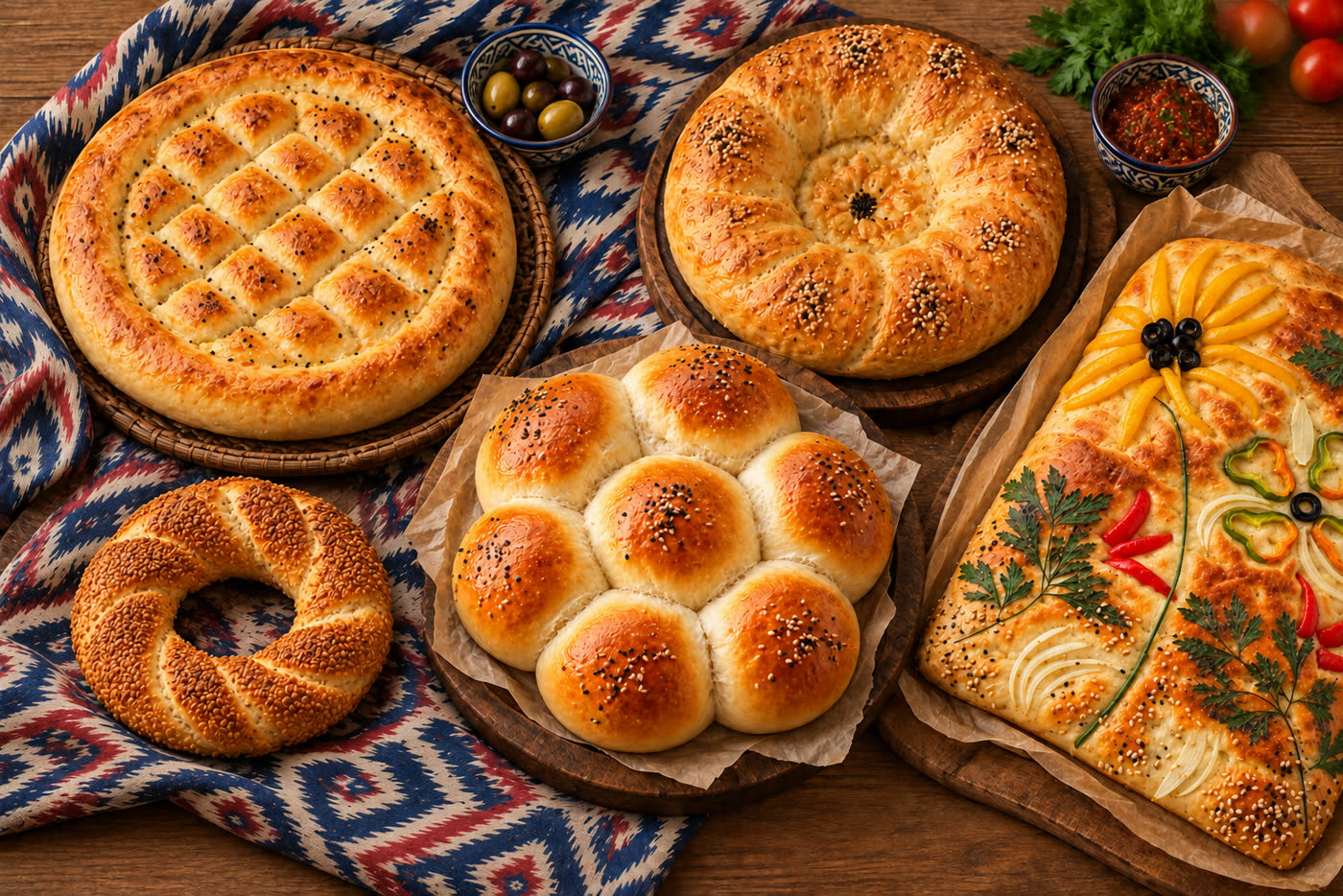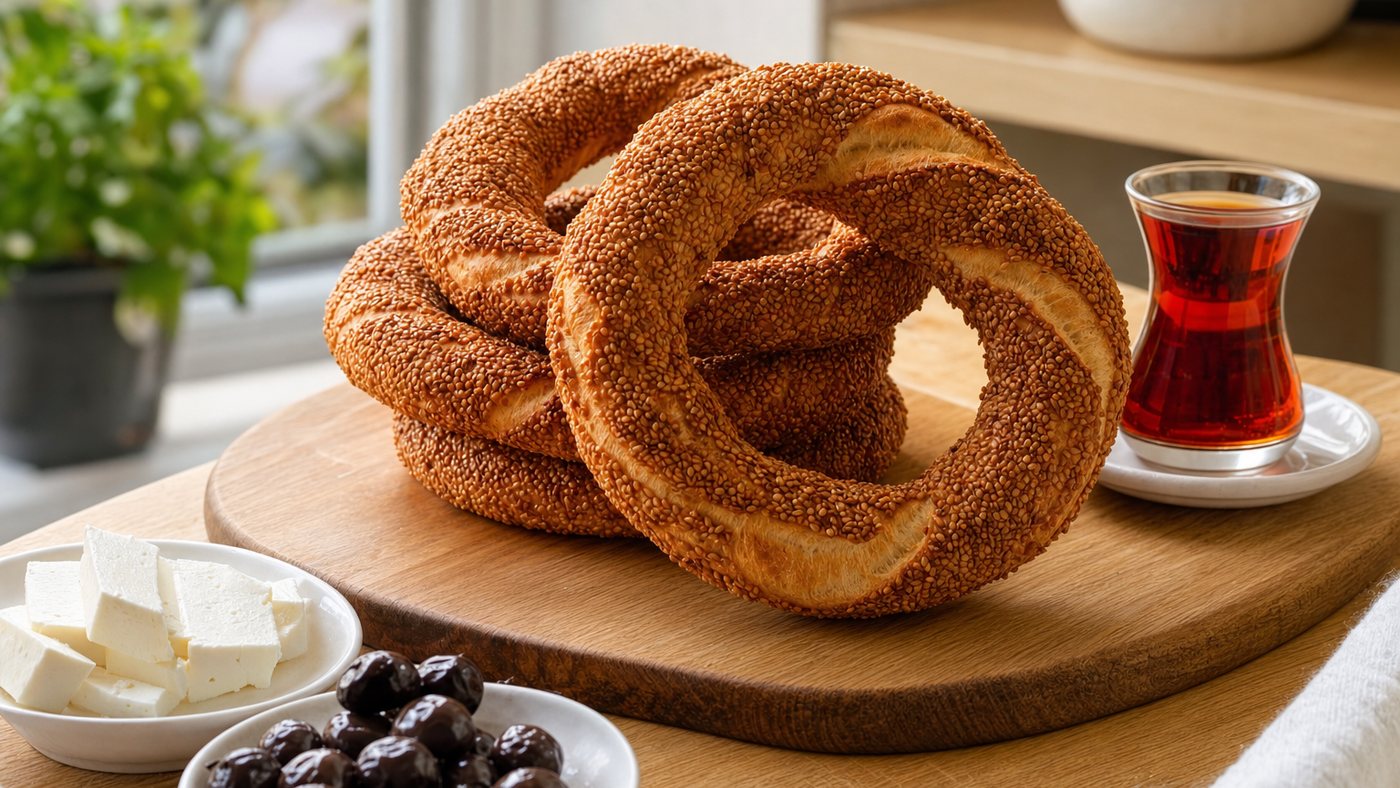
Simit is a Turkish bread ring made from twisted ropes of dough, dipped in molasses thinned with water and rolled in sesame seeds before baking. Crisp outside and slightly chewy inside, it is the most common street bread in Turkiye, the one people eat in the morning with a glass of tea. If you have been to Turkiye or watch a lot of Turkish dramas you will know what I'm talking about ;).
It is often compared to a bagel, and that comparison is misleading. Here is its history in Istanbul, how Turks eat it, a home recipe and how to keep it crisp.
What is simit?
Simit dough is very plain: flour, water, yeast and salt, with no butter or milk. It is rolled into ropes, twisted, closed into a ring, then dipped in diluted molasses and coated in sesame. In the oven the molasses caramelises and glues the seeds on, which gives that deep golden crust that cracks when you bite it. The hole is wide and the ring fairly thin, so you tear it by hand rather than slice it.
It varies a little from city to city. In Izmir it is called gevrek. People often say the Ankara version is darker and crunchier, and the Istanbul one a little softer.
An Istanbul bread since Ottoman times
Istanbul court records dated 1525 are often cited as the earliest known mention of simit. In the 17th century, the traveller Evliya Çelebi also mentions simit bakers among the city's guilds. Exact dates vary between sources, but the main point is not in doubt: simit is a bread of the Ottoman capital, sold in the street for several centuries, and it has stayed an everyday bread, cheap and filling.
The simitçi, Istanbul's street sellers
The man who sells simit is the simitçi. For a long time he carried his stock piled on a large tray balanced on his head, calling out in the streets. Today in Istanbul you mostly find him behind a small glass-sided cart, often red, near bus stops and ferry piers. People buy a simit on the way past, eat it walking or on the ferry deck, and plenty of them throw a piece to the seagulls following the boat.
Molasses, then sesame: the secret of the crust
It comes down to two steps: the raw ring is dipped in a mix of water and molasses, then rolled in sesame, ideally toasted. The molasses gives the colour and a hint of sweetness, and it is what makes the seeds stick.
Traditionally the molasses is pekmez, a reduced grape syrup that is very common in Turkey. We glaze our simit with pomegranate molasses instead. It is a choice in our recipe, and we would rather say so plainly: this is not the classic version. Pomegranate molasses is tangier than pekmez and not so sweet, which you may notice slightly on the crust, still golden and thickly coated in sesame.
How Turks eat simit
Mostly in the morning. On a Turkish breakfast table, the kahvaltı, simit sits next to Turkish tea in small tulip-shaped glasses, white brined cheese (beyaz peynir, similar to feta), olives, tomatoes and cucumber. You tear it and alternate bites. At weekends some people spread it with honey and kaymak, a very thick cream. Split in half, it also makes a good grilled cheese sandwich.
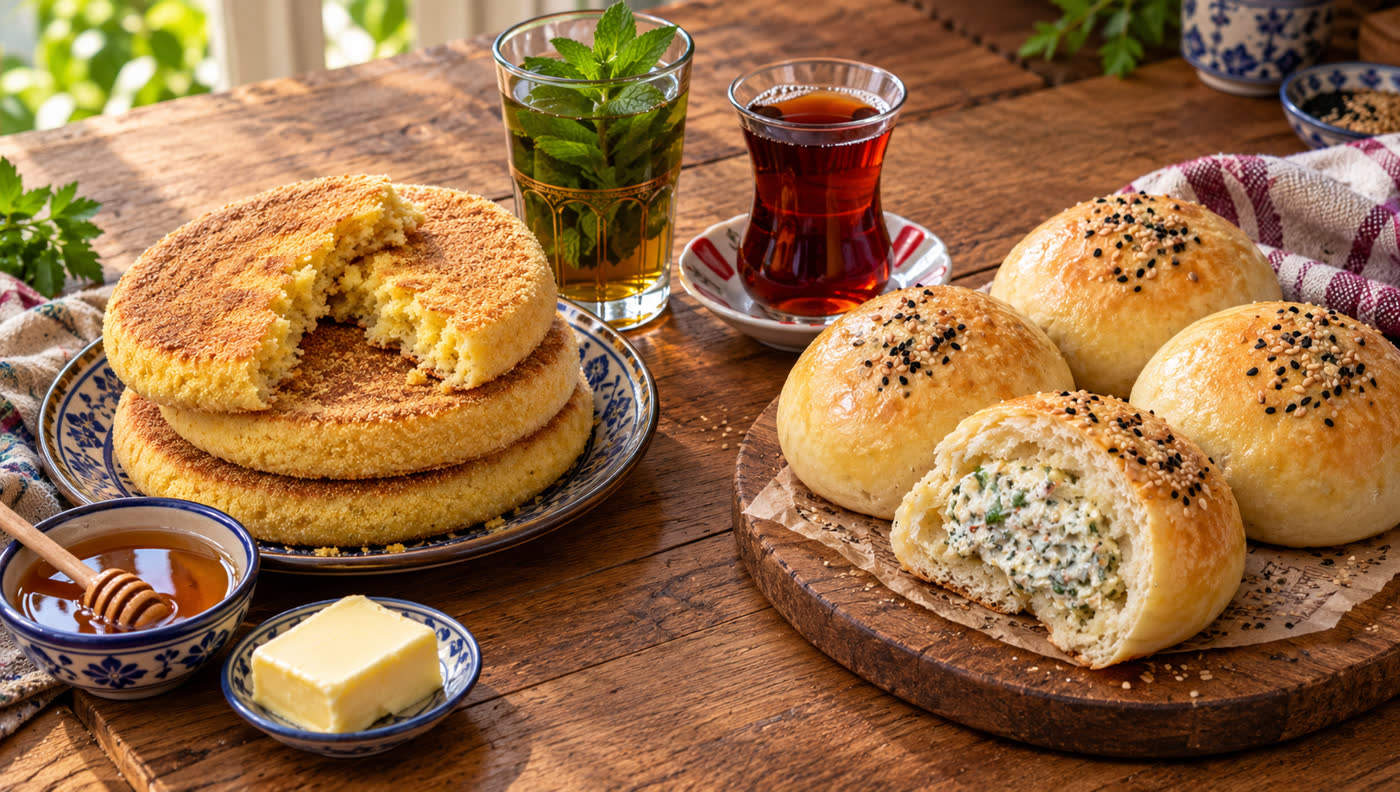
In Tetouan it fits naturally on a Moroccan breakfast table, next to mint tea, jben jibli or La vache qui rit (the laughing cow cheese) and olives. It also sits well next to harcha, which we compare with its Turkish counterpart in harcha or pogaça: the differences.
Simit vs bagel: the differences
| Simit | Bagel | |
|---|---|---|
| Origin | Istanbul, Ottoman era | Eastern Europe (Kraków is often cited), then New York |
| Before baking | Dipped in molasses water | Boiled in water |
| Sesame | All over, always | Optional, like poppy seeds |
| Shape | Thin twisted ring, big hole | Thick smooth ring, small hole |
| Texture | Crackly crust, light crumb | Dense, very chewy crumb |
A bagel is boiled and a simit is not: that is what makes one dense and the other crisp.
Simit's cousins
Sesame bread rings turn up all over the eastern Mediterranean. In Greece, koulouri, especially the Thessaloniki kind, is very close. In Jerusalem, ka'ak, more oval in shape, is also sold in the street, often with zaatar. These breads probably share a history, but it is hard to say who inspired whom.
Homemade simit recipe
For 8 simit:
- 500 g plain flour
- 7 g dried yeast
- 10 g salt
- 1 teaspoon sugar
- about 290 ml lukewarm water
- 4 tablespoons pekmez, or another molasses, and 120 ml water for the dip
- 150 g sesame seeds
- Mix the flour, yeast, salt and sugar, add the water and knead for 10 minutes. The dough should be firm and smooth, firmer than ordinary bread dough, so the twist holds. Leave to rise for 45 minutes to an hour.
- Toast the sesame in a dry pan for 3 to 4 minutes, stirring, until barely golden. In a wide bowl, mix the molasses and water.
- Divide the dough into 16 pieces of 50 g and roll each into a 40 cm rope.
- Twist the ropes together in pairs, then shape into rings about 14 cm across, sealing the ends well.
- Dip each ring in the molasses water for a few seconds, let it drip, then roll it in the sesame, pressing so it sticks.
- Place the rings on a lined tray, stretch them gently to widen the hole and leave to rest for 15 to 20 minutes.
- Bake at 220°C for 15 to 20 minutes, until deep golden.
No pekmez? Date or carob molasses works, or pomegranate molasses like ours, with a slightly tangier result.
Our simit
Our Turkish simit is made with flour, water, yeast and salt. Each ring is hand-twisted from two ropes, dipped in pomegranate molasses, rolled in toasted sesame and baked in the oven. It costs 12 MAD, has about 280 kcal and contains gluten and sesame.
For something sweet, our walnut and fig jam, made from dried figs, crushed walnuts and a little sugar, spreads beautifully on a warm simit. It contains nuts. For something savoury, our simit already comes with a FREE cheese & herb dip: a spoonful on a piece of simit and you have a savoury Turkish breakfast.
Storing and reheating simit
Simit is best on the day, ideally within a few hours of baking: a dough with no fat dries out quickly. Keep it in a paper bag, then in a sealed bag if it has to wait until the next day.
- The next day: dampen it lightly with wet fingertips and give it 4 to 5 minutes in the oven at 180°C.
- Frozen: up to a month, wrapped individually. Reheat from frozen for 8 to 10 minutes at 180°C.
- Stale: cut into cubes and toasted, it makes excellent croutons.
Avoid the microwave: simit goes soft, then hard as wood.
Frequently asked questions
Is simit sweet?
No. The molasses gives the crust a faint sweetness, but it is a savoury bread, as good with cheese as with jam.
Is your simit made with pekmez?
No, with pomegranate molasses. That is our recipe rather than the traditional grape pekmez version, and the crust can taste a little tangier.
Does simit contain eggs or milk?
The traditional recipe doesn't, and neither does the ingredient list of our simit: flour, water, sesame, pomegranate molasses, yeast and salt. It does contain gluten and sesame.
Should simit be eaten warm?
Warm is best. Cold, it is still good on the day, and a few minutes in the oven bring back the crunch.
Where to find our simit in Tetouan
Order your simit on our website as early as you can, since everything is made to order, and collect it on Saturday or Sunday between 10:00 and 18:30 at Wilaya Centre in Tetouan. Come in the morning if you can: it is a breakfast bread.