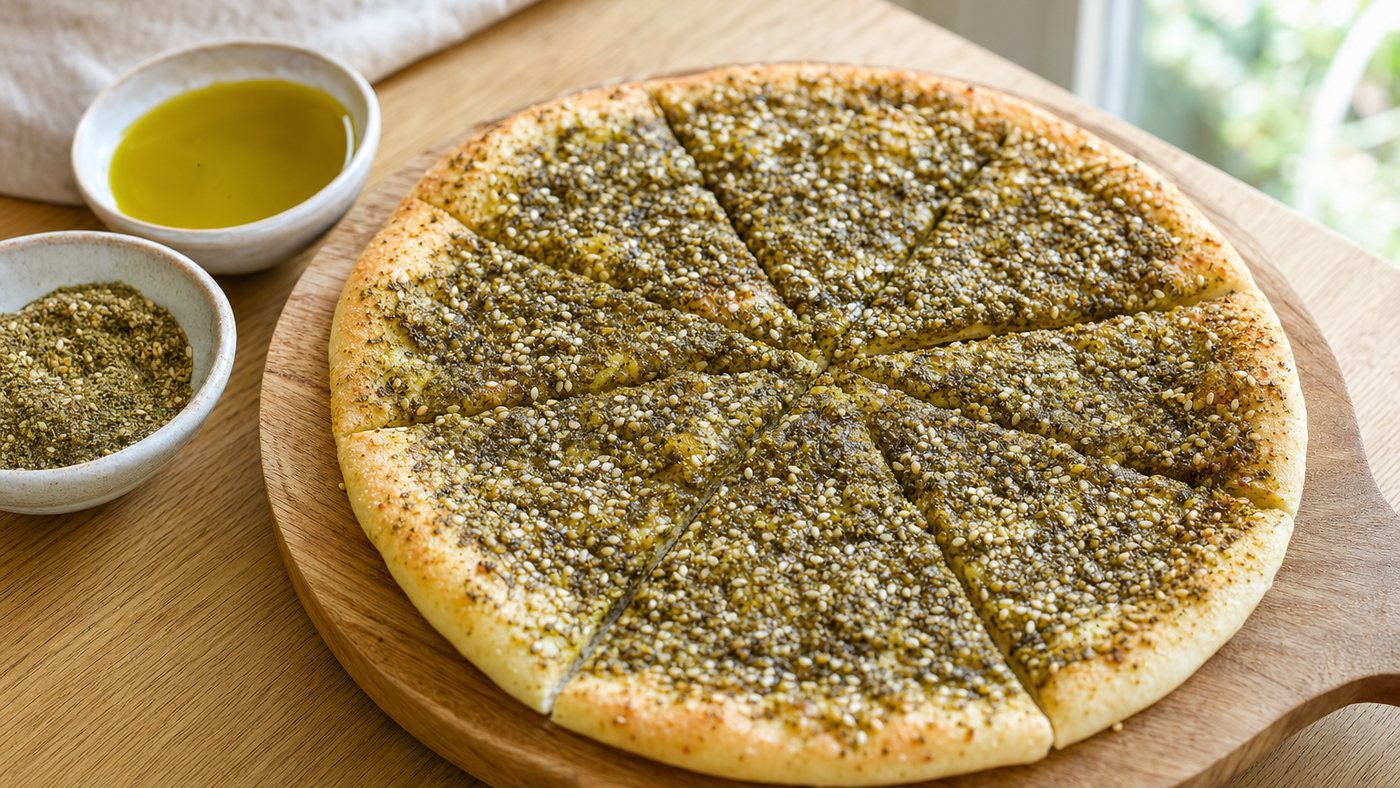
Zaatar bread is a yeasted flatbread spread before baking with a mix of zaatar and olive oil, and eaten warm, often for breakfast. Zaatar itself means two things: a wild herb related to thyme and oregano, and the blend made from it with sumac, toasted sesame and salt.
In the Levant, this bread is called manakish. Here is where it comes from, what zaatar means in Morocco, and how to make both the blend and the bread at home.
Zaatar: a herb and a blend
The word zaatar is used for two things, which causes a fair bit of confusion. In Lebanon, Syria, Palestine and Jordan, it is first of all a wild herb, usually Syrian oregano (Origanum syriacum), which grows on dry hillsides. Depending on the area, the name is also given to certain thymes and savories that look like it.
It is also the name of the blend made with that dried herb. The most common version combines the crushed herb, which gives the green colour, sumac, a ground red berry with a tangy taste, toasted sesame and salt. Every family has its own proportions, and some add marjoram, thyme or a pinch of cumin. Lebanese blends are often said to be redder and richer in sumac, while others let the green of the herb lead.
And in Morocco, what does zaatar mean?
In Morocco the word does not mean quite the same thing. When people say zaatar, they usually mean the herb on its own, dried, generally a local wild oregano. Thyme tends to be called zaitra. Depending on each family's habits, this zaatar goes into certain dishes, with olives, or into tea in winter.
The Levantine blend with sumac and sesame is less common, although some spice sellers stock it. So be specific at the souk: for zaatar bread as they make it in Lebanon, you need the blend, not the herb alone.
What does zaatar taste like?
Zaatar smells of dried herbs, somewhere between thyme and oregano, with a slight bitterness. Sumac adds a gentle sourness without the sharpness of fresh lemon, and toasted sesame rounds it all off. On hot bread, the olive oil releases these aromas: the bread turns savoury and fragrant, and calls for something fresh alongside. It is not spicy unless chilli has been added to the blend.
Where it began: Levantine manakish
The best-known zaatar bread is manakish (singular man'oushe), from Lebanon and the wider Levant. The name is thought to come from an Arabic verb meaning to engrave or mark, because of the dimples the baker presses into the dough with his fingertips.
In Lebanon, people buy it in the morning from the neighbourhood bakery, still hot, and roll it around slices of tomato, cucumber, mint leaves and sometimes labneh. It also comes with cheese, or half cheese, half zaatar. In Palestine, people simply dip bread in olive oil and then in zaatar, and a popular belief says zaatar keeps the mind sharp, so children are sometimes given it on exam days.
Herb, blend, bread: what is what?
| Zaatar (the herb) | Zaatar (the blend) | Zaatar bread | |
|---|---|---|---|
| What it is | A wild plant related to thyme and oregano | A ready-to-use spice blend | A yeasted flatbread, topped before baking |
| Made of | Dried leaves | Herb, sumac, toasted sesame, salt | Yeasted dough, zaatar, olive oil |
| Taste | Herbal, slightly bitter | Herbal, tangy, toasty | Savoury, fragrant, golden underneath |
| Used for | Cooking, olives, tea (in Morocco) | Bread, eggs, salads, labneh | Breakfast, brunch, mezze |
Making your own zaatar blend
For a small jar, enough to top six breads:
- 4 tablespoons dried zaatar, or half dried oregano, half dried thyme
- 2 tablespoons sumac
- 2 tablespoons sesame seeds
- half a teaspoon fine salt
- Toast the sesame in a dry pan for 2 to 3 minutes, stirring, until barely golden. Leave to cool.
- Crumble the herbs between your palms. Avoid the blender, which turns them to powder.
- Mix everything, taste and adjust: more sumac for tang, more herb for a greener flavour.
No sumac? A little grated lemon zest, added when you top the bread, comes close.
Homemade zaatar bread recipe
For 6 breads, 18 to 20 cm across:
- 500 g plain flour
- 7 g dried yeast
- 1 teaspoon sugar
- 10 g salt
- 3 tablespoons oil
- about 300 ml lukewarm water
- for the topping: 6 tablespoons zaatar blend and 8 to 10 tablespoons olive oil
- Mix the flour, yeast, sugar and salt, add the oil and water, and knead for 10 minutes into a soft dough. Cover and leave to rise for an hour.
- Mix the zaatar with the olive oil and leave for 10 minutes. The topping should spread easily, like a thick pesto.
- Heat the oven to 250°C with the baking tray inside, for at least 20 minutes.
- Divide the dough into 6 balls of about 140 g and rest them for 15 minutes. Roll each one out on baking paper into an 18 to 20 cm disc, 5 mm thick.
- Press your fingertips all over the surface, leaving a 1 cm border, then spread on a spoonful of topping. The dimples stop the dough puffing up too much and hold the oil.
- Slide the breads onto the hot tray and bake for 7 to 9 minutes, until the edges and underside are golden.
Two traps to avoid. Dry zaatar burns and turns bitter, so the topping should glisten with oil. And as soon as the herbs darken, take the bread out, even if the edges look a little pale.
What to serve with zaatar bread
- At breakfast: with labneh or jben, olives, tomatoes, cucumber and a few mint leaves, and a glass of mint tea.
- With eggs: fried or in an omelette, with the bread to mop up.
- As mezze: cut into wedges next to a dip. Our cheese, garlic and herb dip, based on soured cream and labneh with garlic, spring onion and dried herbs, is made for it.
- With a salad: Turkish ezme salad, chopped tomatoes and peppers with sumac and mint, carries on the tang of the zaatar.
It also stands in very well for ordinary bread next to a soup or grilled meat.
Our zaatar bread
Our zaatar bread is a yeasted bread, baked to order and generously topped with zaatar, toasted sesame seeds and olive oil. The herbs lead, with the light tang of sumac. A piece of about 100 g costs 10 MAD and has around 245 kcal. It contains gluten and sesame.
Add a cheese, garlic and herb dip (8 MAD, contains milk) and an ezme salad (8 MAD), and you have a complete weekend breakfast.
Storing the bread and the blend
Zaatar bread is best on the day. In a sealed bag it keeps until the next day: warm it for 3 to 4 minutes in the oven at 180°C, or in a dry pan over a medium heat, so the base crisps up again. It freezes for a month, layered with baking paper. The blend keeps for about three months in a closed jar, away from light and heat. After that the sesame can go rancid, so smell it before you use it.
Frequently asked questions
Are zaatar and thyme the same thing?
Not exactly. Levantine zaatar is usually a wild oregano, a cousin of thyme, and the word also means the blend with sumac and sesame. In Morocco, thyme is more often called zaitra.
Can you put cheese on zaatar bread?
Yes, it is very common in Lebanon, half zaatar and half cheese. Ours is made without cheese, with zaatar, sesame and olive oil.
Where can I buy zaatar blend?
From some spice sellers and delicatessens. Ask clearly for the blend with sumac and sesame, or you may be given the herb on its own.
Can zaatar bread be eaten cold?
Yes, but it is much better warm: heat wakes up the herbs and the oil. A few minutes in the oven is enough.
Where to find our zaatar bread in Tetouan
Order it on our website as early as you can, since everything is baked to order, and collect it on Saturday or Sunday between 10:00 and 18:30 at Wilaya Centre in Tetouan. Add a dip or an ezme salad to the same order and everything is waiting for you in one place.