Basbousa, revani and şambali are three versions of the same cake: semolina baked in the oven, then soaked in sugar syrup until it turns soft and moist. Basbousa, from Egypt and the Levant, is the densest; revani, made in Turkey and Greece, is lighter thanks to whisked eggs and a little flour; Turkish şambali is made with yoghurt and often served with cream.
In Morocco, basbousa has found its way into a lot of family kitchens, usually with coconut. Below: what sets these cousins apart, the one rule that makes the syrup work, a home basbousa recipe, and our own sambali, made in Tetouan.
One cake, many names
The idea is old and very simple. You mix semolina with sugar, some fat and something wet (yoghurt, milk or eggs), bake it, then pour syrup over the cake. The semolina drinks the syrup without falling apart, which gives it the moist, slightly grainy texture you recognise from the first bite.
The name changes from country to country: basbousa in Egypt and the Gulf, harissa in Palestine, Jordan and Syria (nothing to do with the Tunisian chilli paste), namoura in Lebanon. Turkey has revani and şambali, and Greece has ravani.
Basbousa, from Egypt to the Levant
Classic basbousa is dense and melting. It is made with semolina, yoghurt, butter or ghee, sugar, sometimes coconut, and usually no eggs. Before baking, it is cut into diamonds with a blanched almond on each. The syrup is flavoured with lemon, sometimes with orange blossom or rose water.
In Egypt, the tin is often greased with tahini, which gives a golden base with a faint sesame taste. There is also basbousa bil qishta, with a layer of thick milk cream in the middle. Syrupy semolina with cold cream: that is the pairing you find in our sambali.
Revani, the lighter one
Revani is made in Turkey and in Greece, where it is called ravani. The difference is all in the batter: the eggs are whisked with the sugar until foamy, then the semolina and a little flour go in. The cake rises more and the crumb is closer to a sponge.
It is often flavoured with lemon or orange zest and topped with coconut or pistachios. The name is often linked to Revan, the old Ottoman name for Yerevan, but that origin is uncertain.
Şambali, the Turkish yoghurt version
Şambali is a Turkish semolina cake associated above all with Izmir, on the Aegean coast. It is tighter and moister than revani, because the batter has a lot of yoghurt in it and often no flour at all. It is cut into squares, frequently with an almond on each.
You also find it filled or topped with kaymak, the thick Turkish clotted cream. The name is written with a cedilla and pronounced "shambali".
Basbousa, revani, sambali: the differences
| Basbousa | Revani | Şambali | |
|---|---|---|---|
| Where it is eaten | Egypt, the Levant, the Gulf | Turkey, Greece | Turkey, especially Izmir |
| Base | Semolina, yoghurt, butter | Semolina, flour, whisked eggs | Semolina, lots of yoghurt |
| Eggs | Often none | Several, whisked to a foam | Few or none |
| Texture | Dense and melting | Light, close to a sponge | Tight and very moist |
| Syrup flavour | Lemon, orange blossom or rose | Lemon or orange | Lemon |
| On top | Almond, sometimes qishta | Coconut or pistachio | Almond or kaymak |
The golden rule: hot cake, cool syrup
This is the most common mistake, and it ruins a cake in a minute. For the semolina to absorb the syrup without going mushy, one of the two has to be hot and the other cool. The safest way: syrup at room temperature, poured over a cake straight out of the oven.
If both are hot, the semolina swells too fast and the cake turns to porridge. If both are cold, the syrup sits on top and the bottom stays dry. So make the syrup first, and pour it in two or three goes, letting the cake drink between each one.
Recipe: homemade basbousa
For a tin of about 20 × 30 cm, which gives 16 to 20 squares. Start with the syrup.
The syrup
- 300 g sugar, 250 ml water, 1 tablespoon lemon juice and, if you like, 1 teaspoon orange blossom water.
- Bring the sugar and water to the boil, then simmer for 8 to 10 minutes, until the syrup lightly coats a spoon. Add the lemon and orange blossom water off the heat and leave to cool completely.
The batter
- 250 g fine semolina, 50 g desiccated coconut, 100 g sugar, 1 heaped teaspoon baking powder, a pinch of salt, 250 g plain yoghurt, 120 g melted butter (or 100 ml oil), about twenty blanched almonds.
- Mix the dry ingredients, add the yoghurt and melted butter, and stir just enough to get a thick batter. Leave it for 20 minutes: the semolina swells and the cake will be softer.
Baking and soaking
- Heat the oven to 180 °C. Grease the tin with butter, or with a spoonful of tahini as they do in Egypt.
- Spread the batter with a wet spatula, score it into squares or diamonds and press an almond onto each.
- Bake for 30 to 35 minutes, until the top is a deep gold. If it stays pale, give it 2 minutes under the grill and keep watching.
- As soon as it comes out, run the knife through the lines again, then pour the cool syrup over the hot cake in two or three goes.
- Leave it to rest for at least two hours before serving.
For a change, orange zest in the batter takes the cake towards revani, and a little rose water in the syrup gives it a Levantine feel.
Our sambali, with cream and pistachio
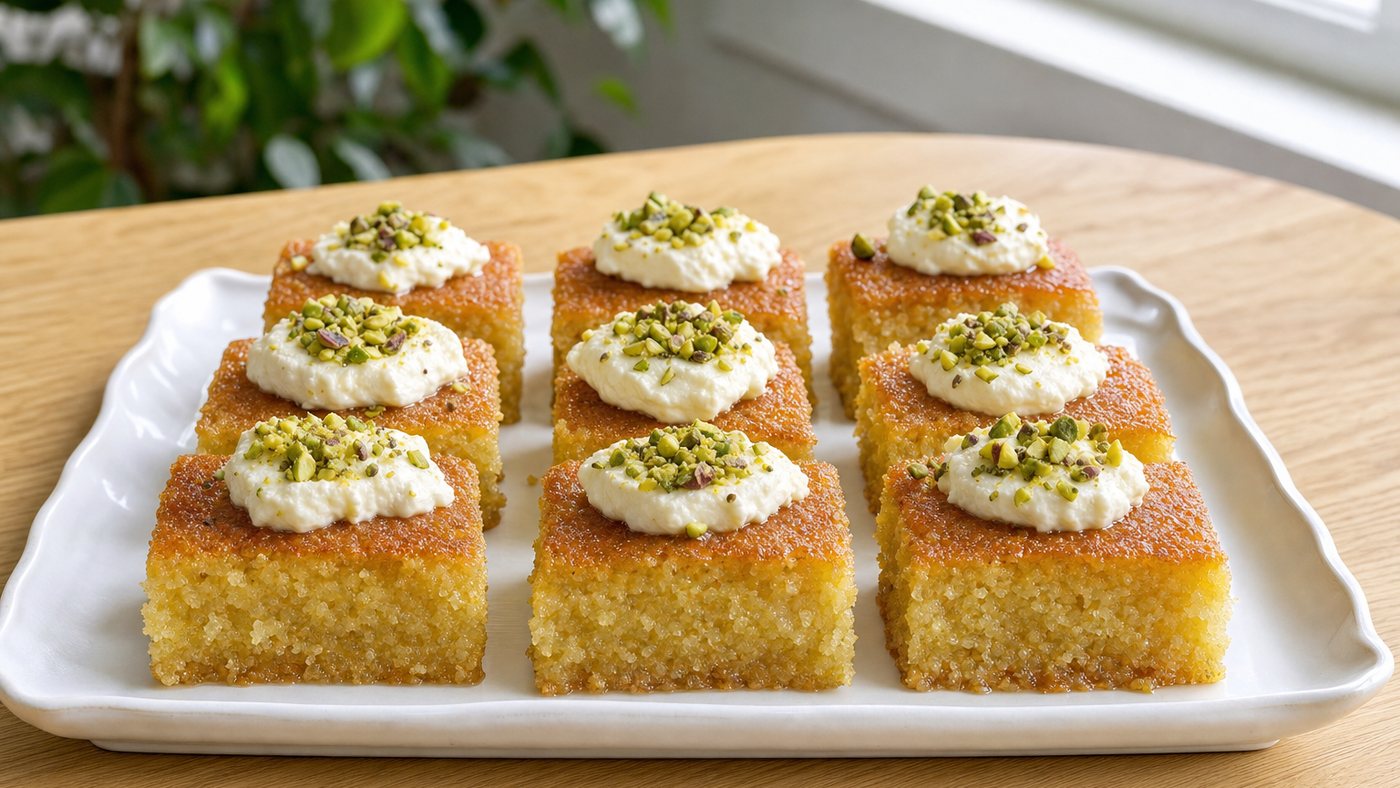
Our Sambali follows the Turkish yoghurt version. The batter is semolina, yoghurt, eggs, oil, sugar and desiccated coconut, with lemon. Once baked and soaked in syrup, it gets a layer of cream and then crushed pistachios as toppings. The cream tames the sweetness of the syrup and the pistachio adds crunch.
It is sold by the slice, about 90 g, at roughly 285 kcal. It contains gluten (semolina), eggs, dairy and tree nuts (pistachios). If you like coconut basbousa, this is probably the one that will feel most familiar.
What to serve it with
A cake this sweet needs a drink that isn't. In Turkey it comes with a small glass of black tea or a Turkish coffee. Here, a lightly sweetened mint tea does the job. During Ramadan, a square of sambali fits right in at ftour.
For a tea party, play with textures: a slice of sambali, a slice of layered Uzbek honey cake, and a slice of Lotus Biscoff Trilece, which is fresher and creamier.
Storing it
Basbousa without cream keeps for two to three days at room temperature, covered, as long as it isn't too hot. In summer, put it in the fridge, where it lasts up to five days. Take it out ten minutes before serving. Cut into squares and well wrapped, it freezes without any trouble.
With cream, it is a different story. Our sambali stays in the fridge, is best eaten the same day or the next, and should not be frozen.
Frequently asked questions
Are basbousa and sambali the same thing?
Almost: both are semolina cakes in syrup. Şambali often has more yoghurt and comes with cream, while basbousa is denser.
Can you make basbousa without eggs?
Yes, that is the classic way, like the recipe above. Eggs belong more to revani.
Why is my basbousa dry?
It probably didn't get enough syrup, or it baked too long. The syrup also needs to go on as soon as the cake comes out, not an hour later.
Why is my basbousa mushy?
The syrup was most likely hot on a hot cake, or there was too much of it. Stick to the rule, cool syrup on hot cake, and pour in stages.
Where to get our sambali in Tetouan
Our Sambali with cream and pistachio is made to order for the weekend. Order it on our website as early as you can, and collect it on Saturday or Sunday at Wilaya Centre in Tetouan, between 10:00 and 18:30. For a big party or a special question, message us on WhatsApp before you order, from the contact page on our website.