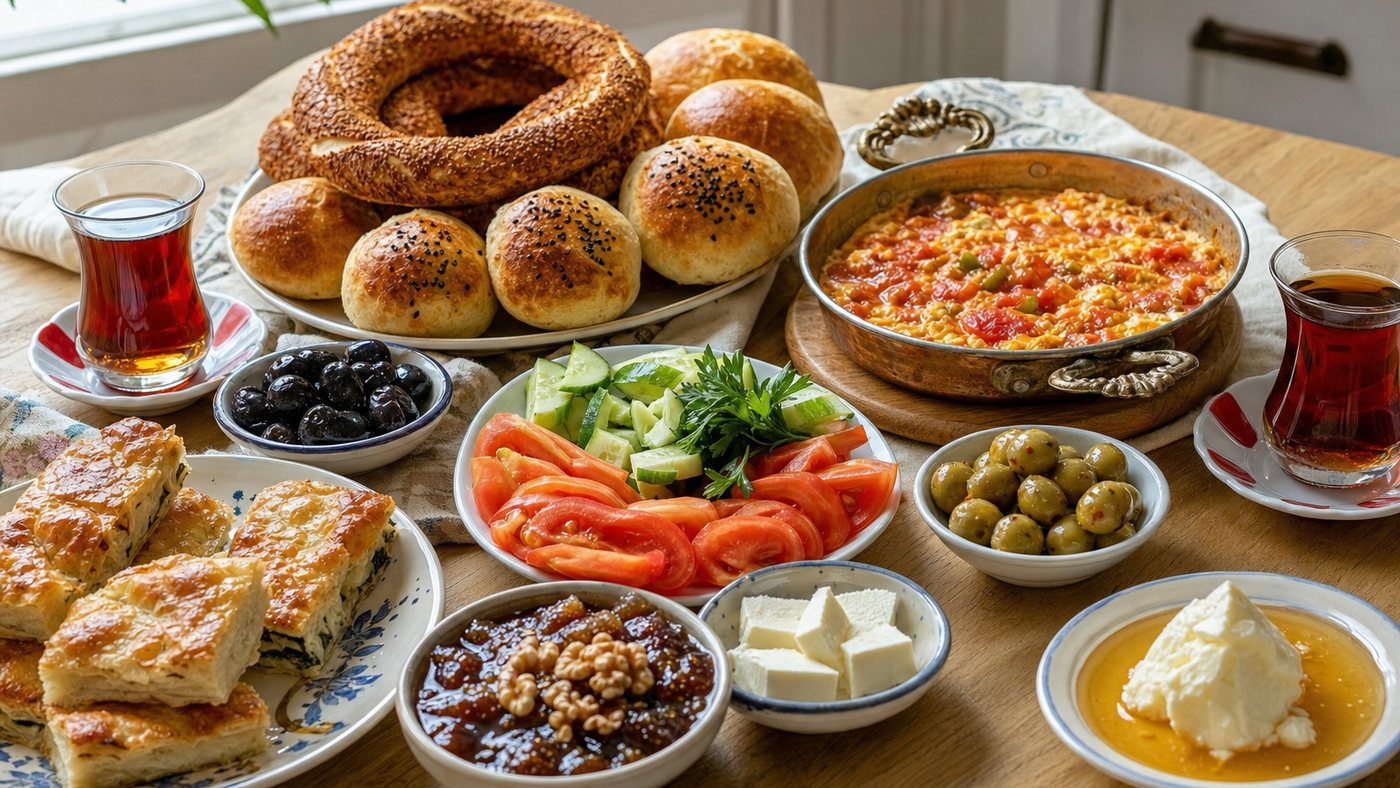
A Turkish breakfast, or kahvaltı, is a big table of small shared plates: white cheese, olives, tomatoes, cucumber, eggs, honey, jams and breads such as simit, with black tea served in tulip-shaped glasses. You can easily recreate it at home in Tetouan by buying the fresh things at the market and ordering the Turkish breads from us to collect on Saturday or Sunday.
Kahvaltı, the meal "before coffee"
The word kahvaltı comes from kahve, coffee, and altı, meaning "under". The usual explanation is that it is what you eat before your coffee, so you don't drink it on an empty stomach. The funny part is that Turks mostly drink tea at breakfast.
On weekdays kahvaltı is often just a simit, a glass of tea and a piece of cheese. On Sunday it becomes a long family meal that can easily last two hours: serpme kahvaltı, the "spread out" breakfast, with dozens of small plates covering the table. The city of Van, in eastern Turkey, is especially famous for its breakfasts.
What goes on a kahvaltı table
There is no fixed menu, but you will almost always find:
- Cheese: beyaz peynir, a white brined cheese close to feta, and kaşar, a milder yellow cheese.
- Olives: black and green, with a drizzle of olive oil.
- Raw vegetables: tomatoes, cucumber, green peppers, parsley.
- Eggs: boiled, fried, or as menemen.
- Something sweet: honey with kaymak, and jams made from cherries, figs or rose petals.
- Breads: simit, pogaça, börek.
Kaymak is a cream so thick it is almost solid, lifted from the surface of milk that has been heated very slowly. It is hard to find in Tetouan. Well-drained labneh with a drizzle of honey gets you fairly close.
Tea in tulip glasses
Turkish tea is black tea brewed in a double teapot called a çaydanlık. In the small pot on top, a very strong tea brews for about fifteen minutes, while the large pot underneath keeps the water hot. Everyone pours a little strong tea into their glass and tops it up with hot water to taste.
It is drunk without mint or milk, from small tulip-shaped glasses held by the rim, and over a long kahvaltı they get refilled three or four times without anyone noticing. If you are used to atay going round all day, you will feel right at home.
The breads: simit, pogaça and börek
Our Turkish simit is a twisted ring of bread dipped in molasses, then rolled in sesame. In Turkey the molasses is usually made from grapes; ours is pomegranate molasses. It is crunchy outside, dense and slightly chewy inside, and you tear it by hand to eat with a bit of white cheese and an olive. Simit has been sold on the streets of Istanbul since Ottoman times.
Pogaça is a soft roll, often filled. Our cheese pogaça has a dough made with milk, yoghurt and egg, and a filling of mozzarella, labneh, garlic, spring onion and dried herbs. It is usually the first thing to disappear from the table. As for börek, very thin pastry rolled around a filling, a square or two each is plenty.
Eggs, and the onion question
At kahvaltı, eggs come boiled, fried, or cooked with sucuk, a spiced beef sausage. The favourite, though, is menemen: tomatoes and green peppers cooked down in a pan, with the eggs cracked in at the last moment. It is a little like shakshuka, only softer.
One question genuinely splits Turkish families: does menemen have onion in it? Without, the tomato and pepper taste cleaner. With, the dish turns sweeter. In our recipe it is optional.
Recipe: menemen for 4
Allow 20 to 25 minutes and a large frying pan, about 26 cm across.
- 4 very ripe tomatoes (about 500 g)
- 3 long, thin green peppers
- 1 small onion (optional)
- 5 eggs
- 2 tablespoons olive oil and a knob of butter
- Salt, black pepper, a pinch of chilli flakes or paprika, a little parsley
- Grate the tomatoes, and the skin stays in your hand. Slice the peppers into thin rings.
- Heat the oil and butter over a medium heat. If you are using onion, soften it for 4 to 5 minutes without letting it colour.
- Add the peppers and let them soften for 5 minutes.
- Add the tomatoes, salt them and let them reduce for 8 to 10 minutes, until the sauce is no longer watery.
- Crack the eggs into the pan and stir gently two or three times with a wooden spoon, then stop: the white and yolk should stay soft.
- Turn off the heat after about 2 minutes, when the eggs have only just set. Add the chilli, pepper and parsley.
Menemen goes to the table in its pan, and everyone dips their bread straight in.
Turkish breakfast vs Moroccan breakfast
The two tables share bread, olive oil, olives, honey and tea that never stops. The real differences are the raw vegetables and the cheese, which matter a great deal in Turkey.
| Turkish kahvaltı | Moroccan breakfast | |
|---|---|---|
| Breads | Simit, pogaça, börek, fresh bread | Msemen, baghrir, harcha, khobz |
| To spread | Butter, honey and kaymak, jams | Olive oil, amlou, butter, honey |
| Cheese | Beyaz peynir, kaşar, often several | Fresh jben, often just one |
| Eggs | Menemen, boiled eggs, eggs with sucuk | Omelette, eggs with khlii |
| Vegetables | Tomatoes, cucumber, peppers, herbs | Fewer, mostly olives |
| Drink | Black tea in tulip glasses | Mint tea, milky coffee |
Nothing stops you mixing the two. Put a bowl of amlou next to the simit and every guest finds something familiar.
Kahvaltı for 4: the shopping list
For four adults and a proper Sunday breakfast, on top of the menemen ingredients:
| Item | Amount for 4 |
|---|---|
| White brined cheese (feta style) | 200 g |
| Semi-hard cheese (edam style) | 150 g |
| Black and green olives | 250 g in total |
| Tomatoes and cucumbers | 3 tomatoes, 2 cucumbers |
| Eggs for boiling | 4 |
| Honey, and labneh or thick cream | A small jar, 150 g |
| Butter and jam | 100 g, 1 or 2 jars |
| Black tea | 4 tablespoons |
Serve each thing on its own small plate and slice the vegetables at the last minute. Put our walnut and fig jam next to the white cheese: that sweet and salty pairing is one Turks love. On the morning, boil the eggs first and make the menemen last.
Allergens to know about
Turkish simit contains gluten and sesame. Cheese pogaça contains gluten, eggs and dairy. Walnut and fig jam contains walnuts, which are tree nuts. Turkish ezme salad has no major allergens listed. Full details are on each product page.
Frequently asked questions
Why does kahvaltı mean "before coffee"?
The word joins kahve, coffee, and altı, "under". In other words, the meal that comes before your coffee.
Can I eat a Turkish breakfast at your place?
No. We are not a café or a restaurant, and there is no seating. Everything is ordered on the website and collected to take home.
How do I keep simit until the next day?
In a paper bag at room temperature. In the morning, a few drops of water on the crust and 4 to 5 minutes in the oven at 180°C bring the crunch back.
What can I serve with boiled eggs instead of menemen?
A Turkish ezme salad: tomatoes, peppers, onion and herbs chopped very fine, with pomegranate molasses and sumac. It has a little heat and goes very well with eggs.
Your weekend Turkish breakfast, from us
For four people, this order covers the whole bakery side of the table:
- 4 Turkish simit: 48 MAD
- 4 cheese pogaça: 40 MAD
- 1 pot of walnut and fig jam: 10 MAD
- 1 pot of Turkish ezme salad: 8 MAD
That comes to 106 MAD. All that is left is to buy the fresh things and make the tea. For big appetites, add one or two black olive pogaça at 6 MAD each.
Order on our website as early as you can, since everything is made to order for the weekend. Collection is on Saturday or Sunday, between 10:00 and 18:30, at Wilaya Centre in Tetouan. For an early Sunday breakfast, collect on Saturday, keep the cheese pogaça in the fridge overnight, and warm everything for 5 minutes at 180°C in the morning.