There's something wonderfully comforting about a slice of honey cake and a freshly brewed cup of tea.
Perhaps it's the gentle sweetness of the honey, the creamy filling, or simply the pleasure of sitting down for a little treat after a busy day.
Whatever it is, honey cake has a special place in many homes across Uzbekistan and other parts of the former Soviet Union.
But here's something that might surprise you: not all honey cakes are the same.
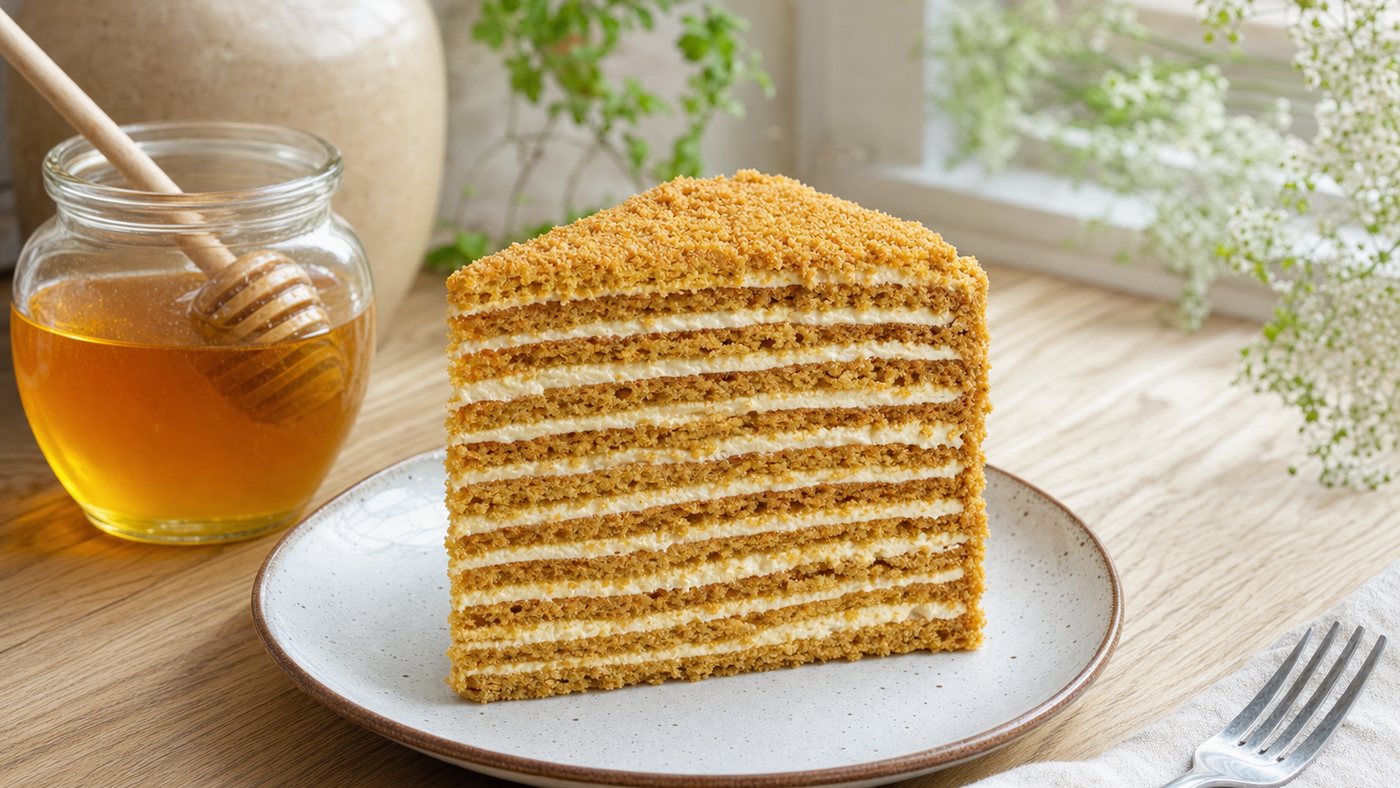
If you've ever seen a Russian Medovik, you'll probably remember its beautiful stack of thin, delicate layers, with cream tucked between each one.
Our Uzbek Honey Cake at Samarkand Bakery is rather different.
We make ours with three thicker layers of honey cake, prepared from a batter rather than rolled dough, and filled with a rich condensed milk buttercream.
Both are delicious in their own way, and both celebrate the lovely flavour of honey.
So, let's explore the story behind these cakes, how they're made, and what makes each one special.
What Is Russian Medovik?
Medovik is one of Russia's best-known honey cakes.
Its name comes from the Russian word myod, meaning honey, and it's traditionally made with multiple thin layers of honey-enriched dough.
You'll often find six, eight or even ten layers, although recipes vary.
The dough is rolled out very thinly and baked into individual rounds. When they first come out of the oven, these rounds are relatively firm, almost like biscuits.
But something rather lovely happens when they're stacked with cream.
Over several hours, moisture from the filling gradually softens the layers, turning them into a tender cake that slices beautifully.
The outside is often covered in fine crumbs made from leftover pieces of baked dough.
And when you cut into it, you see all those delicate layers, one above the other.
It's a beautiful cake, and I can understand why so many people love it.
The Legend of the Empress Who Didn't Like Honey

There's a charming story associated with the origins of Medovik.
According to a popular legend, the cake was created in the early nineteenth century at the court of Russian Emperor Alexander I.
His wife, Empress Elizabeth Alexeievna, supposedly disliked honey so much that the palace kitchen avoided serving it.
Then one day, a young pastry chef who hadn't been told about her dislike prepared a layered honey cake.
The empress tasted it, loved it, and was delighted to discover that the very ingredient she thought she disliked could taste so wonderful.
It's a lovely story, isn't it?
But we should remember that it's a culinary legend rather than a historically confirmed account haha. There isn't reliable contemporary documentation proving that it actually happened. What we do know is that honey cakes became popular across the Soviet Union, appearing in bakeries, cafés and family kitchens.
And that brings us to Uzbekistan.
How Honey Cake Became Popular in Uzbekistan
Uzbekistan has a wonderful baking tradition of its own, with recipes and techniques passed down through generations. But its food culture has also been influenced by centuries of contact with neighbouring countries and communities.
During the Soviet period, many recipes became familiar across different republics, and Russian-style cakes were among them. Medovik was one of those desserts.
Today, you can find honey cakes in bakeries and cafés in cities such as Tashkent and Samarkand, often served with tea or brought out when guests visit.
But here's where things become interesting. Not every honey cake made in Uzbekistan follows the classic Russian Medovik recipe. Some bakers prepare the familiar thin, rolled layers, while others use thicker cake layers and different methods. And that's something I really enjoy about traditional food.
Recipes travel, families adapt them, and over time, different versions become part of people's own baking traditions.
At Samarkand Bakery, we make one of those different styles.
Our Uzbek Honey Cake: Three Layers of Soft, Honey-Flavoured Cake
Unlike classic Russian Medovik, our Uzbek Honey Cake isn't made by rolling out numerous thin sheets of honey dough.
Instead, we prepare a honey cake batter and build the finished dessert with three thicker layers. That gives it a softer, more substantial, cake-like texture.
Between those layers, we spread a rich buttercream made with sweetened condensed milk. The combination is wonderfully comforting. You get the gentle flavour of honey in the cake, followed by the smooth richness of the cream. And because the layers are thicker, each slice has a very different appearance from the many fine layers of a traditional Medovik.
I wouldn't say one is better than the other. They're simply two different ways of enjoying a honey-flavoured dessert. I think that's part of the fun of discovering food from different cultures.
Uzbek Honey Cake vs Russian Medovik: What's the Difference?
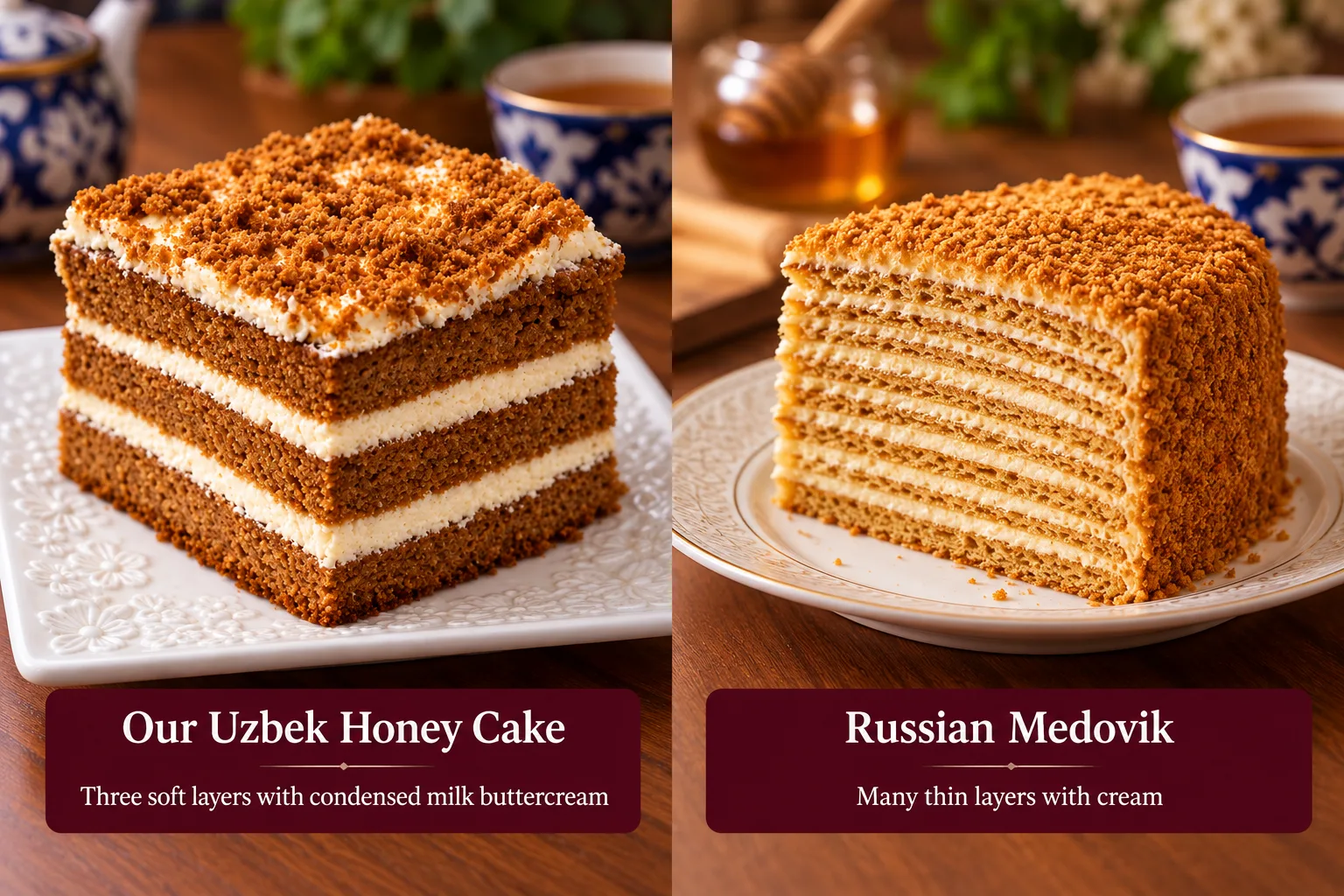
Here's how the classic Russian Medovik compares with the Uzbek Honey Cake we prepare at Samarkand Bakery.
| Feature | Russian Medovik | Our Uzbek Honey Cake |
|---|---|---|
| Cake preparation | Honey-enriched dough | Honey cake batter |
| Number of layers | Usually 6–10 thin layers | 3 thicker layers |
| Texture | Thin layers softened by cream | Soft, substantial cake layers |
| Cream filling | Often soured cream or buttercream | Condensed milk buttercream |
| Appearance | Numerous delicate layers | Three clearly defined layers |
| Main flavour | Honey, cream and caramel-like notes | Honey and rich, creamy buttercream |
Of course, these are comparisons between two particular styles, not strict rules for every cake made in Russia or Uzbekistan.
There are plenty of regional and family variations. But if you've tried classic Medovik before, this explains why our Uzbek Honey Cake looks and tastes a little different.
The Secret Behind Russian Medovik's Delicate Layers
One of the most interesting things about traditional Medovik is how its dough is prepared. Unlike an ordinary sponge cake, the honey dough is often made by gently heating honey, sugar and butter together, sometimes over a bain-marie.
That's simply a heatproof bowl placed over a saucepan of simmering water.
Eggs are incorporated carefully, followed by bicarbonate of soda. The mixture may foam and deepen in colour as it heats.
Once flour is added, it becomes a soft dough that can be divided and rolled into thin rounds. These rounds bake quickly and emerge relatively firm. The real transformation happens later, when they're layered with cream and left to rest.
This is the traditional Medovik method, not the batter-based method we use for our Uzbek Honey Cake.
Why Russian Medovik Needs an Overnight Rest
If you try eating freshly assembled Medovik, you might wonder what all the fuss is about. The layers can still be quite firm, and the cream hasn't had time to work its magic. But leave it in the fridge overnight, and the texture changes beautifully.
Moisture from the filling moves into the baked layers, softening them and helping the whole cake come together. The next day, you can cut through the cake much more easily. And instead of separate firm rounds and cream, you have a lovely, tender layered dessert.
It's one of those recipes where patience really does make a difference.
Our Uzbek Honey Cake also benefits from resting after assembly, but because its layers are made from a batter, the starting texture is different.
Recipe: Traditional Russian Medovik at Home
If you're curious about the Russian version, here's a home recipe for a classic eight-layer Medovik.
This is not the recipe for our Samarkand Bakery Uzbek Honey Cake, but it's a lovely way to experience the difference for yourself.
Makes: Approximately 12–14 slices
Cake size: 22cm
Preparation: Approximately 2 hours, plus overnight chilling
Ingredients for the Honey Dough
-
3 eggs
-
200g sugar
-
100g honey
-
100g butter
-
1 level teaspoon bicarbonate of soda
-
Approximately 450g plain flour
-
A pinch of salt
Ingredients for the Cream
Choose one of these fillings.
Option 1 – Condensed Milk Buttercream
-
250g softened unsalted butter
-
Approximately 390g sweetened condensed milk
Option 2 – Soured Cream-Style Filling
-
600g thick crème fraîche
-
150g sugar, or approximately half a tin of condensed milk
Step 1 – Prepare the Honey Dough
Place the butter, honey and sugar in a heatproof bowl over a saucepan of gently simmering water.
Stir for approximately five minutes until the mixture is smooth.
In a separate bowl, beat the eggs.
Gradually whisk a small amount of the warm honey mixture into the eggs, then slowly return everything to the main bowl while whisking.
Continue gently heating and stirring for another two to three minutes.
Add the bicarbonate of soda and stir as the mixture foams.
Remove from the heat, then gradually add the flour and salt until a soft, slightly sticky dough forms.
Step 2 – Roll and Bake the Layers
Divide the dough into eight equal portions while it's still warm.
Roll each portion very thinly on baking paper.
Prick lightly with a fork.
Bake at 180°C in a preheated oven for approximately five to six minutes, until golden.
While each layer is still warm, use a 22cm plate or cake ring to trim it into a neat circle.
Keep the trimmings for decorating the finished cake.
Allow the layers to cool.
Step 3 – Prepare the Cream
For the condensed milk buttercream, beat the softened butter until light and creamy.
Gradually add the condensed milk while continuing to beat.
For the soured cream-style filling, whisk the thick crème fraîche with sugar until combined.
Keep the filling chilled until you're ready to assemble the cake.
Step 4 – Assemble the Medovik
Place the first cake round on a serving plate.
Spread a thin, even layer of cream over it.
Add the next round and repeat until all eight layers are stacked.
Use the remaining cream to cover the top and sides.
Crush the reserved baked trimmings into fine crumbs and gently press them over the cake.
Step 5 – Let the Cake Rest
Cover and refrigerate for at least eight hours, ideally overnight.
This gives the cream time to soften the layers.
And then comes the best part: cutting that first slice and seeing all those beautiful layers!
A little tip: avoid adding too much bicarbonate of soda, as it can leave an unpleasant taste.
And don't worry if the freshly baked layers seem firm. That's normal for this style of cake.
What Should You Serve with Honey Cake?
Personally, I think honey cake is at its loveliest with a cup of tea.
In Uzbekistan, both green and black tea are popular, and an unsweetened cup makes a wonderful contrast to a rich dessert.
A light mint tea is lovely too.
If you'd prefer something cold, our Uzbek Fruit Kompot, made with fruit such as apples, peaches and grapes, is a refreshing accompaniment.
And if you're preparing a dessert selection for guests, why not serve honey cake alongside our Sabali or Trileçe?
One offers the comforting richness of honey and buttercream, while the other brings a softer, milk-soaked texture.
It's a lovely combination for a family gathering or afternoon tea.
How to Store Honey Cake
Because honey cakes usually contain dairy-based fillings, they should be kept refrigerated.
For homemade Medovik, store the cake covered in the fridge and follow a suitable food-safe storage period for the ingredients and preparation method used.
Many people enjoy Medovik even more after it has rested overnight, because the layers have had time to soften.
If the cake contains buttercream, letting an individual slice stand briefly at room temperature before serving can improve its texture. Don't leave it unrefrigerated for extended periods.
For our Samarkand Bakery Uzbek Honey Cake, keep your slices refrigerated and enjoy them within 3 days of your order.
Frequently Asked Questions
Are Russian Medovik and Uzbek Honey Cake the Same?
Not necessarily.
Some honey cakes made in Uzbekistan closely resemble Russian Medovik, but others use different recipes and preparation methods.
Our Samarkand Bakery Uzbek Honey Cake is made with three thicker, batter-based layers and condensed milk buttercream, rather than the many thin, rolled dough layers of classic Russian Medovik.
Why Does Medovik Have So Many Thin Layers?
The thin layers are a defining feature of the classic Russian style.
After baking, they're stacked with cream and allowed to rest until the layers soften.
Can You Make Medovik Without Soured Cream?
Yes.
Condensed milk buttercream is another popular option, and thick crème fraîche can also be used in some recipes.
Why Are My Medovik Layers Hard After Baking?
That's often normal.
The layers are supposed to soften after spending several hours in contact with the cream.
If they remain too firm after an overnight rest, they may have been rolled too thickly or baked for too long.
Which Honey Is Best for Honey Cake?
A mild floral honey is a lovely choice because it gives sweetness and flavour without overwhelming the other ingredients.
Stronger honeys can also work, but they produce a more pronounced taste.
Does Uzbek Honey Cake Contain Nuts?
That depends on the recipe.
Our honey cake doesn't contain nuts, however it does contain wheat flour, eggs and dairy and some times some processed ingredients do have traces of nuts. For any additional ingredients, including nuts, please check the current allergen information before ordering.
Where to Find Uzbek Honey Cake in Tetouan
If you'd like to try our version, we'd be delighted to prepare a slice for you.
At Samarkand Bakery, our Uzbek Honey Cake is made with three soft honey-flavoured layers and rich condensed milk buttercream.
It's prepared to order in our home kitchen and available for weekend collection in Tetouan.
You can explore our desserts and place your pre-order through the Samarkand Bakery website.
Collection: Wilaya Centre, Tetouan
Days: Saturday and Sunday
Ordering: Advance pre-orders through our website
And if you're curious about how our Uzbek Honey Cake compares with Russian Medovik, we'd love to hear your thoughts after you've tried it.
A Little Sweetness, Shared Across Cultures
One of the things I love most about traditional baking is seeing how familiar ingredients can become something completely different in another kitchen.
Honey, flour, eggs and cream are simple ingredients.
But put them into the hands of different bakers, following different family traditions, and you can end up with wonderfully different cakes.
Russian Medovik has its delicate layers and beautiful, softened, slightly chewy texture.
Our Uzbek Honey Cake has its three thicker layers, rich buttercream and comforting, soft, cake-like bite.
Both have their own story.
And here at Samarkand Bakery, we're happy to share a little piece of that story with our customers in Tetouan.
From our little kitchen to your family table, with love.