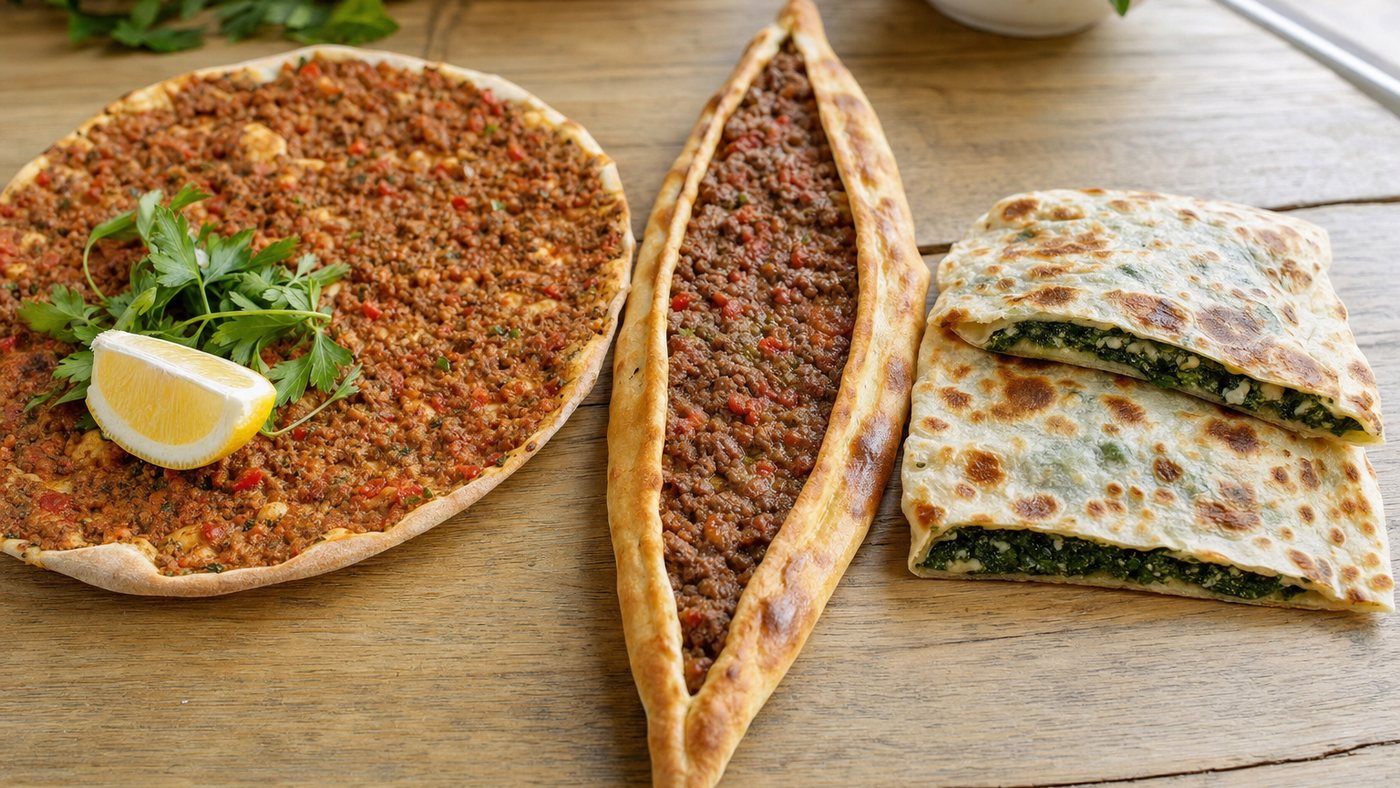
Lahmacun is a very thin round flatbread spread with a light layer of spiced minced meat, baked for a few minutes in a very hot oven, then rolled up with parsley, sliced onion and lemon. Pide is a boat-shaped yeasted dough, available with a variety of different toppings and baked in the oven until golden and crisp. Gözleme is an unleavened dough rolled out very thin with flour, filled, folded and cooked on a griddle. The quick way to tell them apart: lahmacun is rolled, pide is cut into strips, and gözleme is folded.
Here in Tetouan we make pide and gözleme, lahmacun is on its way. Below: all three in detail, which one to pick, and a lahmacun recipe to make at home.
Lahmacun, the thin meat flatbread
Its name comes from the Arabic lahm bi'ajin, "meat with dough", and that is what it is called in Syria and Lebanon. In Turkey it is mostly linked with the cities of the south-east, Gaziantep and Şanlıurfa above all, each of which defends its own style, more or less spicy, more or less garlicky etc.
The dough is rolled out very thin, into a disc of 25 to 30 cm. It is covered with a raw layer of minced meat mixed with onion, tomato, pepper, parsley and chilli, spread right to the edge. It bakes in a few minutes in a very hot stone oven: the meat cooks at the same time as the dough, which stays soft in the middle and crisps around the edges.
Pide, the filled boat
Pide is a yeasted bread dough, rolled into an oval and topped in the middle. The sides are then folded in and pinched at both ends, which gives it its boat shape. The topping is generous and stays on show: minced meat, small cubes of meat, kaşar cheese, egg, or sucuk, the spicy Turkish sausage. The Black Sea region is famous for its long, thin pide. Out of the oven, the edges are often brushed with butter and the pide is cut into strips to share.
The same word is also used for the round Ramadan bread, but it refers to a seperate thing. Ramazan pidesi is a yeasted fluffy and soft flatbread marked with a pattern and scattered with sesame and nigella seeds, which people in Turkey still buy warm just before iftar. Don't get them mixed up!
Gözleme, the folded flatbread from the griddle
Gözleme is the simplest of the three: flour, water and salt, with no yeast. The dough is rolled out very thin with a long rolling pin called an oklava, filled on one half, then folded into a half-moon or a square. It cooks on a sac, a large domed griddle set over the fire, with a little butter.
It is village food. At markets and along roadsides in Turkey you often see women rolling out the dough and cooking it to order. The classic fillings are white cheese with parsley, spinach, potato and minced meat. The name is said to come from göz, "eye", perhaps for the golden spots that form as it cooks, though nobody is certain.
The big comparison table
| Lahmacun | Pide | Gözleme | |
|---|---|---|---|
| Dough | Bread dough rolled very thin | Yeasted, thicker at the edges | Unleavened, rolled very thin |
| Shape | Round and flat | Boat with pinched ends | Folded into a half-moon or square |
| Topping | Raw meat spread to the edge | Thick, open in the middle | Sealed inside the dough |
| Cooking | Very hot oven, 5-10 minutes | Oven, about 20 minutes | Griddle or pan, a few minutes on each side |
| Texture | Soft, crisp edges | Golden, soft edges | Thin, soft but crisp in places |
| How it's eaten | Rolled, with parsley onion & lemon | Cut diagonally | Rolled or cut into triangular pieces |
| When | Lunch, snack | A meal to share | Breakfast, brunch |
| At our bakery | Coming Soon! | Yes | Yes |
Which one to choose, and when
- A quick lunch: a rolled lahmacun. It is so thin that most people happily eat two.
- A family meal: pide, cut into strips in the middle of the table. Allow one minced beef pide per person, a little less if there are salads too.
- Weekend breakfast: a hot gözleme with a glass of tea.
- Vegetarian guests: spinach gözleme, potato gözleme or a spinach pide.
- A gift or a party table: our Artisan Garden Pide, decorated by hand and gift wrapped.
Lahmacun is coming soon to our bakery, until then, here is a recipe to try out!
To be clear, lahmacun is not on our menu. It is best eaten straight out of the oven, which is a good reason to make it at home. For 6 lahmacun:
- Dough: 300 g flour, half a teaspoon dried yeast, 1 teaspoon salt, 1 tablespoon oil, about 180 ml warm water
- Topping: 250 g minced lamb or beef, not too lean, 1 onion, 1 tomato, half a green pepper, 2 garlic cloves, a small bunch of parsley, 1 tablespoon tomato purée or pepper paste, 1 teaspoon chilli flakes, half a teaspoon cumin, salt, pepper, 1 tablespoon olive oil
- To serve: parsley, sliced red onion, lemon
- Mix the dough ingredients and knead for 8 minutes until soft. Cover and leave to rest for an hour.
- Pulse the onion, tomato, pepper, garlic and parsley into small pieces without turning them into a purée. Drain off any excess juice, then mix by hand with the raw meat, tomato purée, spices and oil.
- Heat the oven as high as it goes, 250°C or more, for 30 minutes, with an upturned baking tray inside.
- Divide the dough into 6 balls and roll each into a very thin disc of about 25 cm. Spread 3 tablespoons of topping in a thin layer right to the edge, using the back of the spoon.
- Slide it onto the hot tray on a sheet of baking paper and bake for 5 to 7 minutes, until the edges are golden and the meat is cooked.
- Stack the lahmacun as they come out of the oven, face to face, under a tea towel. They stay soft and roll without cracking.
The secret is a very thin layer of meat. Too thick, and it releases water and the base stops crisping.
Our pide and gözleme
Everything we make is prepared to order for the weekend:
- Minced beef pide, 20 MAD: yeasted dough topped with minced beef cooked with onion, garlic, tomato purée, paprika, cumin, coriander and oregano. Contains gluten and may contain sesame.
- Spinach gözleme, 10 MAD: spinach, onion, garlic, lemon juice, olive oil and paprika, cooked in a pan. Contains gluten.
- Potato gözleme, 8 MAD: potato, onion, butter, cumin, paprika and parsley, pan cooked with no added oil. Contains gluten and dairy.
- Artisan Garden Pide, 20 MAD: our Ramadan pide dough, decorated with vegetables, herbs, olives and nigella seeds, about 280 g, wrapped like a gift. Every loaf is unique, and the vegetables change depending on what we have to hand. Contains gluten.
Storing and reheating
These flatbreads are best on the day. In the fridge they keep for a day or two, well wrapped. Reheat pide for 5 to 8 minutes in the oven at 180°C, and gözleme for a few minutes on each side in a dry frying pan so it crisps up again. Lahmacun only needs 2 to 3 minutes, or it turns hard. Avoid the microwave, which makes the dough soggy.
Frequently asked questions
Is lahmacun a Turkish pizza?
No, It is often called that, like pide, but it has no cheese and no sauce. It is a very thin flatbread whose raw topping cooks with the dough.
Can you make lahmacun without meat?
Yes. Replace the meat with very finely chopped vegetables, tomato, pepper, onion and parsley, bound with tomato purée or pepper paste. Drain the mixture well before spreading it.
Is gözleme eaten hot or cold?
Hot, straight from the pan, while the dough is still crisp. Cold, it loses its crunch, but a minute in a pan brings it back.
What do you drink with these flatbreads?
In Turkey it is nearly always ayran, salty and ice cold. With a breakfast gözleme, it is more often a glass of black Turkish tea.
Where to find our Turkish flatbreads in Tetouan
Order your pide and gözleme on the Samarkand Bakery website, then collect them on Saturday or Sunday, between 10:00 and 18:30, at Wilaya Centre in Tetouan. For a party table, think of the Artisan Garden Pide. Everything is made to order, so order as early as you can. For a large quantity, message us on WhatsApp before you order, from the contact page on the website.